
Kickstart unattended install: the OEMDRV auto-load convention and EL10 syntax pitfalls measured (a fully automated install on record)
What you will learn
Section titled “What you will learn”The complete loop of unattended OL installs via Kickstart: the OEMDRV auto-load convention, a ks.cfg that runs clean on EL10 (with two measured syntax/path pits), artifact verification, and install-as-code in practice.
Auto-loading: the OEMDRV convention (zero kernel arguments)
Section titled “Auto-loading: the OEMDRV convention (zero kernel arguments)”Put ks.cfg on a cdrom/USB labeled OEMDRV, attach it to the machine — Anaconda detects and loads it automatically at startup:
# Seed on the PVE side (the directory holds only ks.cfg)mkdir ksseed && cp ks.cfg ksseed/genisoimage -output oemdrv.iso -volid OEMDRV -joliet -rock ksseed/qm set <vmid> --ide3 local:iso/oemdrv.iso,media=cdromMeasured: after picking Install in GRUB the takeover is zero-interaction (screenshot sequence: GRUB → automated install → reboot). For fleet installs, every machine gets the same seed disk, or fetch the ks over HTTP with inst.ks=http://… (intranet scenarios).
A ks.cfg that runs clean on EL10 (with the measured pits fixed)
Section titled “A ks.cfg that runs clean on EL10 (with the measured pits fixed)”url --url=https://yum.oracle.com/repo/OracleLinux/OL10/baseos/latest/x86_64repo --name=appstream --baseurl=https://yum.oracle.com/repo/OracleLinux/OL10/appstream/x86_64lang en_US.UTF-8keyboard ustimezone Asia/Shanghairootpw OLks-2026 --plaintextnetwork --bootproto=dhcp --activate --hostname=ol-ksbootloader --timeout=1autopartclearpart --all --initlabelselinux --enforcingreboot%packages@coreopenssh-server%end%postecho "kickstart-applied $(date)" > /root/ks-proof.txtprintf "PermitRootLogin yes\n" > /etc/ssh/sshd_config.d/99-ks-rootpw.conf%endTwo pits measured first-hand:
sshpwauthis removed in EL10 —Unknown command: sshpwauthaborts the install outright (screenshot 23). Root SSH with a password moves to a %post writing into sshd_config.d (as above);- Repository URL casing is inconsistent — baseos uses
/OL10/baseos/latest/x86_64while appstream is/OL10/appstream/x86_64(no latest; measured 404 vs 200 side by side). One wrong segment and the installation source errors back into interactive mode.
Artifact verification: install as code
Section titled “Artifact verification: install as code”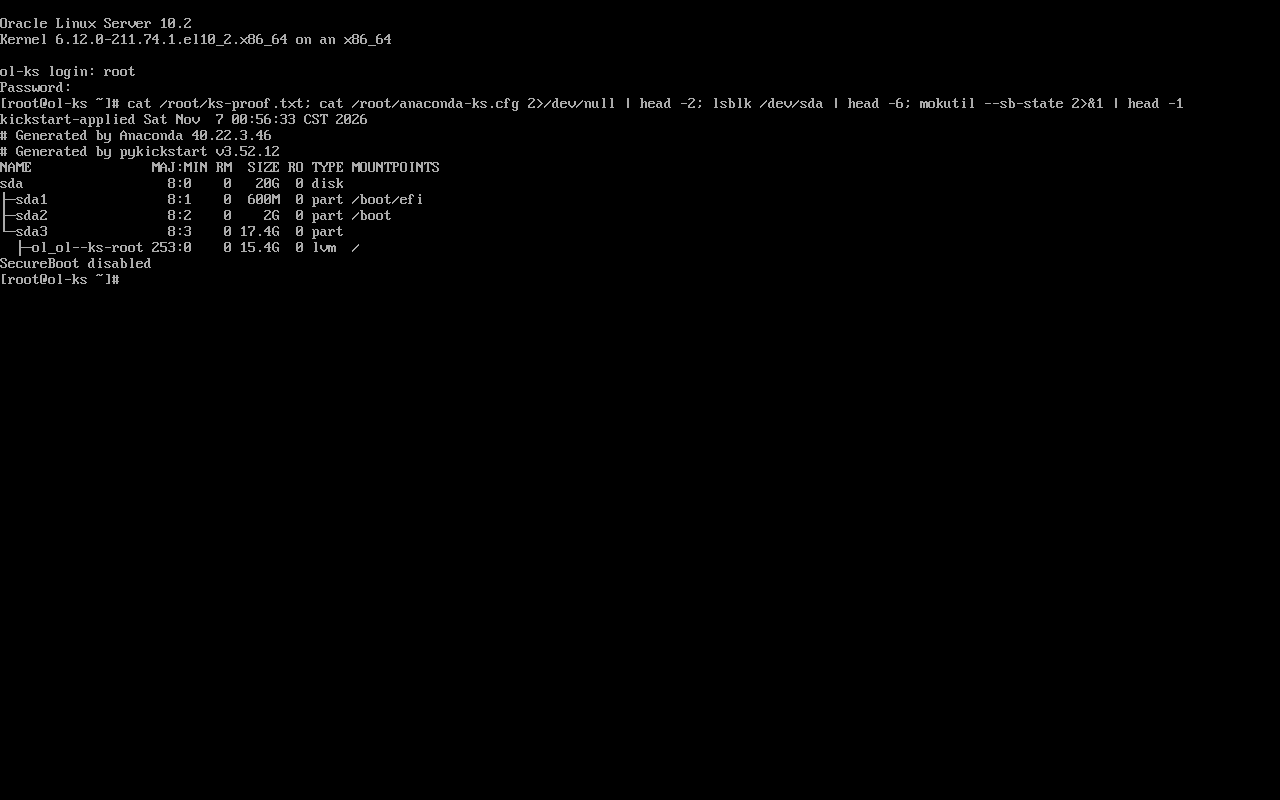
Verification after the automatic reboot (measured output):
cat /root/ks-proof.txt# kickstart-applied Sat Nov 7 00:56:33 CST 2026head -2 /root/anaconda-ks.cfg# # Generated by Anaconda 40.22.3.46# # Generated by pykickstart v3.52.12anaconda-ks.cfg is the complete replay of this install (partitioning/packages/network, all machine-readable) — commit it to git and every machine’s install becomes code; the next machine only changes hostname/IP.
Combined with UEFI
Section titled “Combined with UEFI”The same ks.cfg works under both BIOS and UEFI firmware (clearpart --initlabel creates the matching partition table; bootloader installs the matching bootloader) — this page was measured under OVMF with the ESP created automatically (see the layout comparison in the UEFI install page).
Evidence and limits on this page
Section titled “Evidence and limits on this page”- Measured: OEMDRV auto-loading, two EL10 syntax pits, a fully automated install to 455 packages, %post/anaconda-ks.cfg artifacts (E3, 3 screenshots);
- Not measured: fetching the ks over HTTP (intranet scenarios), fine-grained %packages customization, explicit LVM partitioning (autopart defaults were used);
- Sources: RHEL/OL Kickstart documentation, the
pykickstartsyntax reference, this site’s measured logs.